
Current implementation: the shared-RAM contract and engineering record
Learning and reuse.
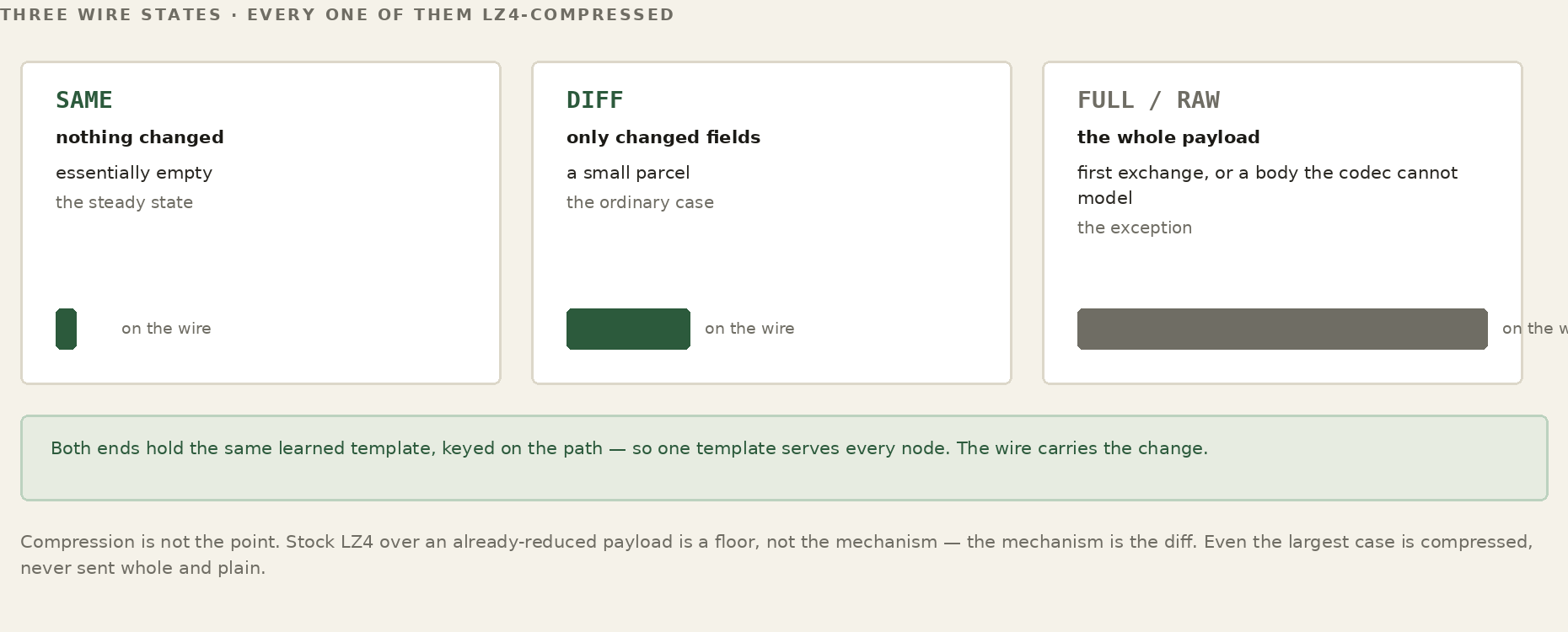
A full representation establishes the structure and state needed at both ends. SAME represents an unchanged answer; DIFF represents changed values against learned structure. A permanent session and library-held semantic cache avoid paying the same representation cost on every operation.
Application views have another purpose.
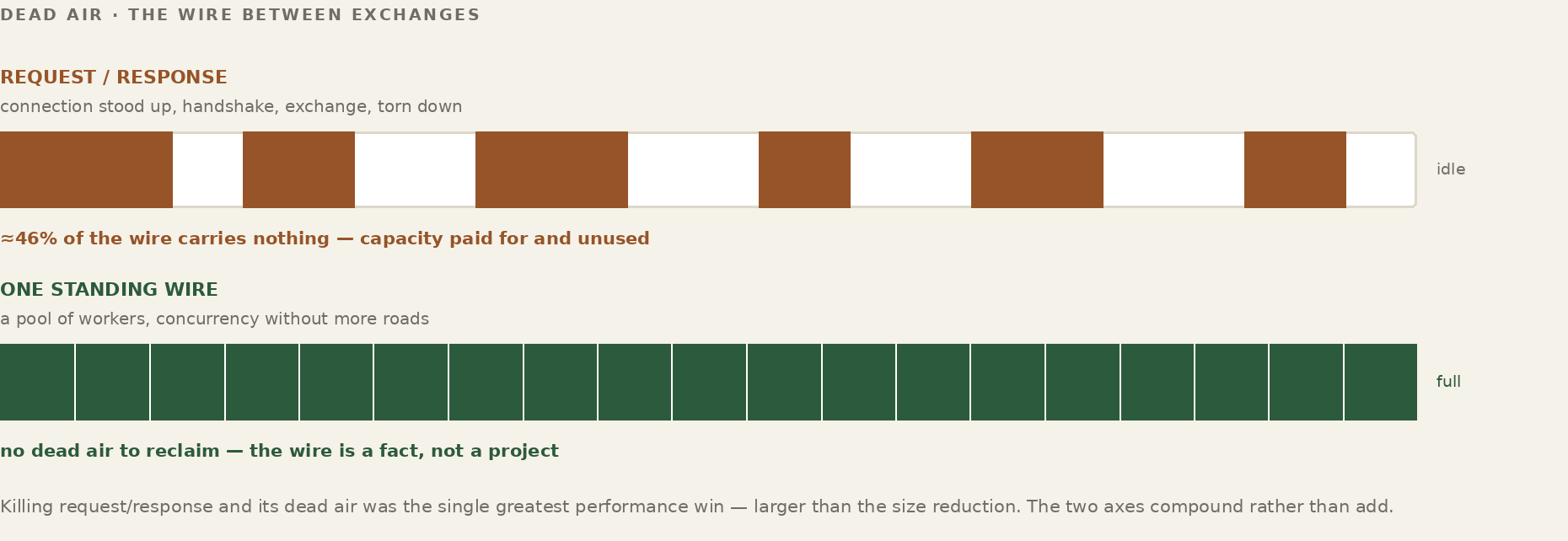
A participant holds a view so it can compute and answer from its present knowledge. The semantic cache reduces the bytes required to maintain that knowledge. The application should not recreate transport caching just to avoid repeated representation.
Published measurements.
The earlier pipe_workload campaign reports 2.3× to 8,741× ratios for different shapes. The large result is mostly static megabyte structure with six changing fields. Churning telemetry has a different result. A 21-byte SAME frame excludes the rest of the concrete network exchange.
The hot echo comparison averaged 118 ms against 201 ms direct Apache in the recorded run. Neither number is a portable service latency bound. Read the accounting context.
Protocol versions and clients.
The older HTTP proxy/daemon path and the modern stand-alone session client are different entry points. FNWP-1/BLDC-1 descriptions from the original specification must not be merged with FNW1 session layouts without reading their code.
The Kotlin member intentionally uses RAW frames. Interoperability establishes its protocol contract; it does not claim semantic compression for that client.
Not a security control.
Structure suppression is not cryptography. Region authentication, authorization and confidentiality are the operator’s or vendor’s policy. Read the separate boundaries.