
Current implementation: the shared-RAM contract and engineering record
Key/value stores.
A key/value interface can resemble a cell operation. The Ribbit programming discipline also specifies ownership, latest versus distinct addresses, held views, marks and coordination as state. The difference must be visible in the application and its contract, not asserted from a label.
Distributed shared-memory systems.
Do not infer transparent machine-pointer coherence, replication or a global heap from Network Shared RAM. The state is explicitly addressed by tuples. Placement and recovery policy belong to the deployment and region.
Message brokers.
Applications publish present truth and hold the state they depend on. A record that must be observed distinctly has its own address. There is no general promise that repeatedly replacing one cell retains every previous value. The transports still exchange protocol messages below the application.
VPNs and overlays.
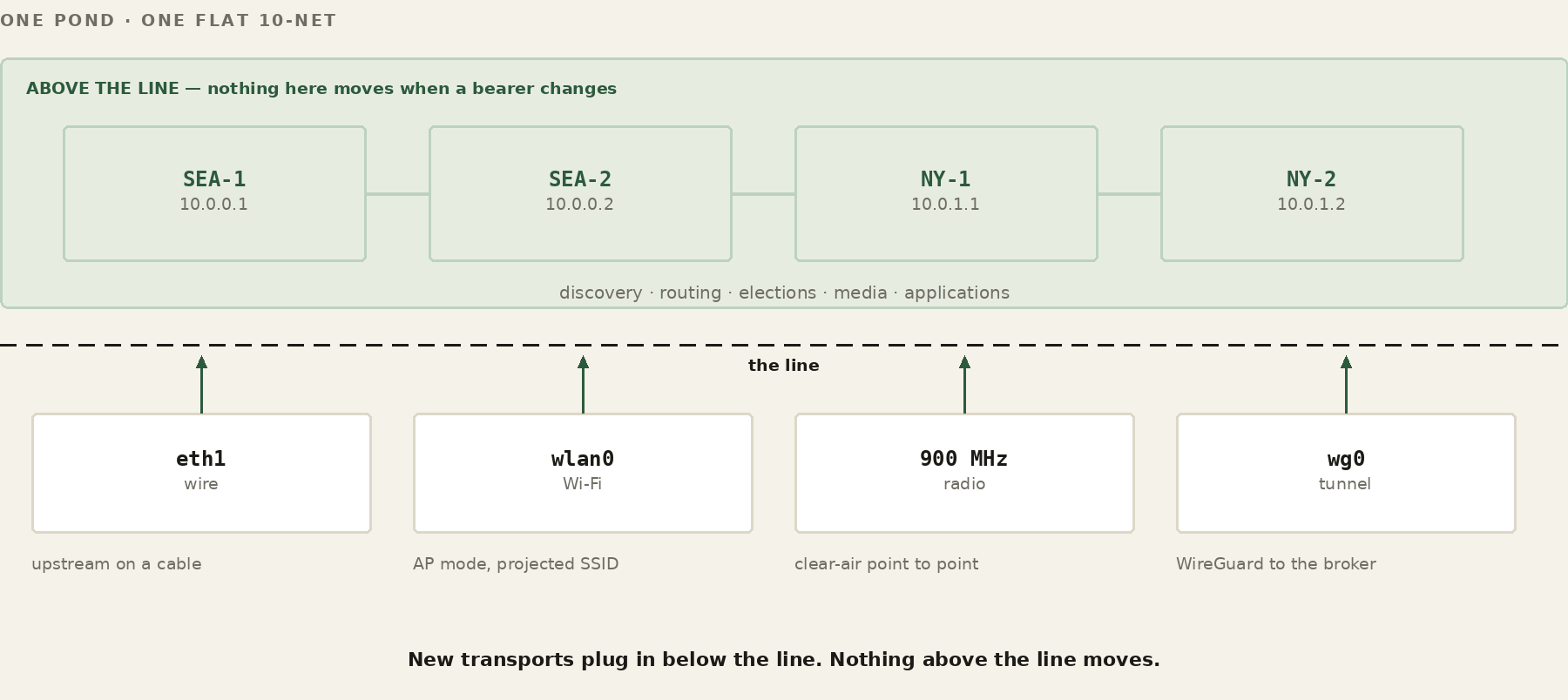
FD&F provides shared-state membership and path construction. Its current packet bridge uses WireGuard and a TUN. The application does not configure peers; the region provides the facts and policy. A comparison that says it uses no tunnel technology would erase an actual implementation dependency.
Existing systems as controls.
FrogTorch compares against Gloo, Redis behavior against Redis, lispers.net wire output against the incumbent, and RINA flows against their required semantics. The comparison is useful only with its test, workload and conditions. Read those records.